A free tool for UK charities

Who funds charities like yours?

Every funder database tells you what's open for applications. Almost none of them tell you who is actually disposed to fund a charity like yours.

Funder Map reads the public record instead: just over a million grants that UK funders have published, joined to the Charity Commission register. Type your charity's name below and it finds the charities that share your funders, the charities registered to do what you do, and then the funders who back those charities far more often than they back everyone else.

No AI writes any of this. Every funder on your report traces back to real, published grants, and you can see them. The only thing this page sends anywhere is the charity number you pick.

Funder Map

This is evidence, not advice. A funder appearing on your report means it has repeatedly funded charities that look like yours on the public record. It doesn't mean you're eligible, and it doesn't mean they're open. Check the funder's own site before you spend an evening on an application.

Find your charity

Name or charity number, whichever you know. England and Wales for now.

No charity in mind? See a report for , or , a village charity with no published grants to its name.

Fair warning if you're on a phone: the report is a wide document with charts, and it reads best on a laptop or bigger screen. Run it here by all means, then copy the link and open it somewhere roomier.

What this can see, and what it can't

Funder Map only knows about grants that funders choose to publish through 360Giving, the UK's open standard for grants data. A few hundred funders publish; thousands don't. So an empty section on your report doesn't mean nobody funds work like yours. It means the funders who do haven't published, and that is worth knowing in itself.

For what's open to applications right now, the directories do that job well: Charity Excellence's Funding Finder, My Funding Central, and GOV.UK's Find a Grant for government money. This report answers the question they can't: which funders' past behaviour suggests they'd lean your way.

And if the report points you at a funder and the next step is the application itself, that's a conversation I enjoy. Email me, or read about the rest of what I do.


Start with a discovery

The first step is always the same, and it's a small one: a short, fixed-price discovery. Over a couple of weeks I work out what your team is already doing with AI, where your data actually lives, and the one thing worth building first. You get a written report and a call to talk it through, with no obligation to go further. It's genuinely useful on its own, whether or not we end up building anything.

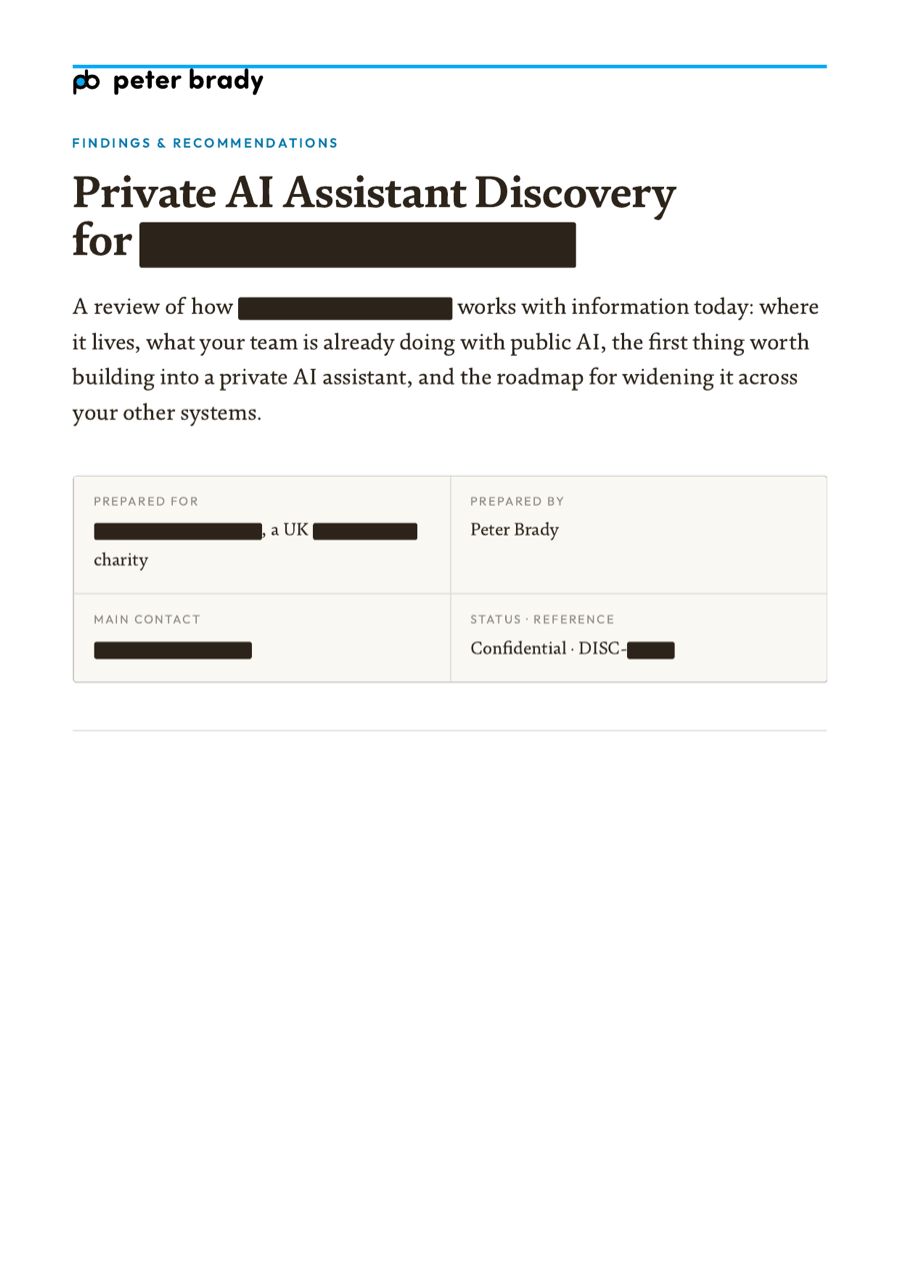
Here's a sample, laid out exactly as the real one is delivered.

Cover of a sample Private AI Discovery report, prepared for a UK charity
See the sample report → PDF, opens in a new tab

For context: I work mainly with UK charities and non profits, with chief executives, operations and finance directors, programme leads, and the people who look after data and IT. Respectfully, I don't work with recruitment or development agencies.

Not sure it's time for that yet? Just email me, tell me who you are and what your organisation does: peter@peterbrady.co.uk